
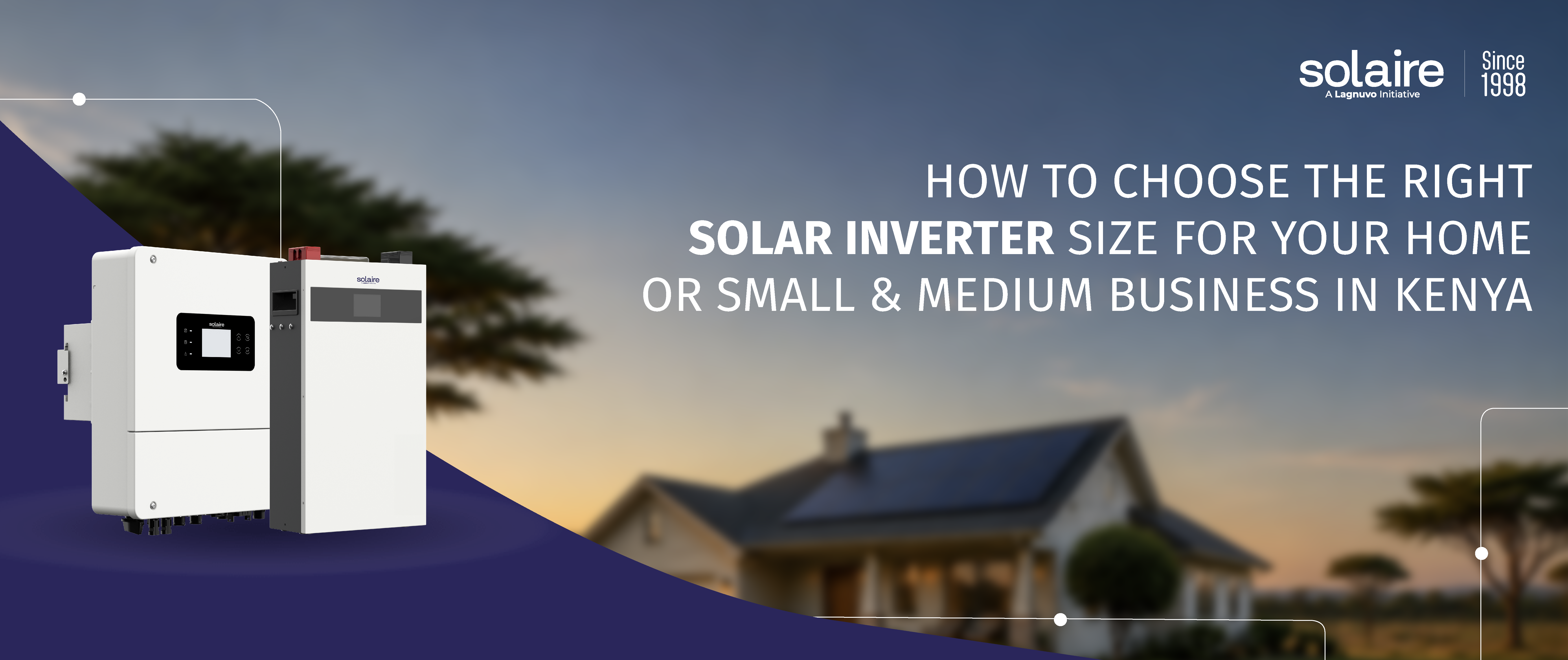
How to Choose the Right Solar Inverter Size for Your Home or Small & Medium Business in Kenya
How to Choose the Right Solar Inverter Size for Your Home or Small & Medium Business in Kenya
If you are planning a solar installation in Kenya, choosing the right inverter size is one of the most important decisions you will make. A system that is too small may overload or limit performance, while a system that is too large can increase your investment without delivering proportional value. Whether the setup is for a home or a growing business, the right sizing decision affects reliability, savings, and long-term flexibility.
In 2026, this has become even more relevant because more homeowners and SMEs are looking for better backup, lower electricity costs, and smarter energy planning. In this guide, we will explain how solar inverter sizing Kenya works in simple terms, what to consider before choosing capacity, and how solar inverter prices Kenya should be viewed alongside system performance and practical inverter benefits.
You can explore Solaire Africa's solar energy solutions to see how residential and commercial power needs are being addressed across different inverter categories.
Start with your actual load.
The first step in solar inverter sizing Kenya is understanding the load you want the inverter to support. For a home, this may include lights, fans, television, refrigeration, Wi-Fi, and a few small appliances. For a small or medium business, the list may expand to include laptops, POS systems, printers, CCTV, routers, lighting, refrigeration, or light machinery.
The most practical way to start is to list the appliances you expect to run at the same time and total their wattage. This gives you a useful picture of your running load. That load, along with startup surges and future expansion, forms the basis for choosing inverter capacity.
One of the biggest inverter benefits of correct sizing is that the system performs more smoothly in everyday use. It reduces the risk of overload and gives the user better confidence in how the solar system will behave during busy hours or outages.
Think about your power source strategy.
The next question is how the system is meant to operate. Some homes and SMEs want a system that works as backup while staying connected to the grid. Others want something more independent, especially in locations with weak or unreliable power supply.
For many users in Kenya, a hybrid solar inverter Kenya setup is a flexible option because it can work with solar panels, batteries, and the grid together. That gives users more control over when to use stored power, when to rely on solar directly, and when to draw support from the utility network.
Solaire Africa's hybrid inverter solutions are positioned around this kind of flexible energy use, which is why hybrid systems are increasingly relevant for homes and SMEs looking for both savings and backup.
Add room for surges and growth.
Sizing should never be based only on current average demand. Refrigerators, pumps, compressors, and some office equipment draw a higher starting current, which means the inverter must be able to manage more than the steady running load.
This is why solar inverter sizing Kenya should include safety headroom. It is also wise to think ahead. A family may add more appliances over time, while an SME may add extra workstations, cooling loads, or equipment as operations grow. Planning for that now can save the cost and disruption of replacing the inverter too early.
In practical terms, one of the most important inverter benefits is future readiness. A well-sized system can adapt better as the user's needs evolve.
Homes and SMEs do not size the same way.
A typical household usually prioritizes essential comfort and backup reliability. A small business, however, often needs more dependable daytime continuity because downtime can affect sales, service, or customer experience.
That is why a home may do well with a smaller hybrid setup focused on lighting, refrigeration, and key appliances, while an SME may need a higher-capacity system designed around continuous daily use. For some businesses, inverter selection also must account for more demanding load behaviour and longer operating hours.
For users comparing system direction, Solaire Africa's product portfolio shows how residential and commercial energy needs can be approached differently depending on scale and usage pattern.
How to think about solar inverter prices in Kenya
Many buyers begin with solar inverter prices Kenya, which is understandable. Price matters. But price should not be treated as the only deciding factor because sizing, performance, service support, and long-term flexibility all affect value.
A lower-priced inverter may seem attractive at first, but if it is under-sized or poorly matched to the application, the user may experience overloads, limited backup performance, or costly system upgrades later. In contrast, a better-matched system may offer stronger inverter benefits over time, even if the upfront cost is higher.
This is why solar inverter prices Kenya should always be compared alongside battery requirements, load profile, system type, and future growth plans.
Which option makes sense in 2026?
For many households and SMEs in Kenya, a hybrid solar inverter Kenya setup is likely to be the most versatile choice in 2026. It offers flexibility, better energy management, and stronger support for backup use without forcing complete disconnection from the grid.
That does not mean one size fits all. The right decision still depends on how the user consumes power, how often outages occur, and how much resilience the system is expected to provide. But when looking at real-life inverter benefits, hybrid systems often stand out for balancing savings, battery support, and operational convenience.
Make sizing a practical decision.
The best approach to solar inverter sizing Kenya is not to chase the biggest system or the cheapest price. It is to choose a solution that matches real power demand, future expectations, and the level of backup required.
Whether the system is being built for a family home or a growing SME, correct sizing helps protect performance and improve long-term value. And when comparing solar inverter prices Kenya, it is always worth remembering that the better decision is usually the one that balances affordability with the right inverter benefits and a reliable hybrid solar inverter Kenya strategy where needed.