
Hybrid vs Off-Grid Solar Inverters: Which Is Better for Kenyan Homes in 2026?
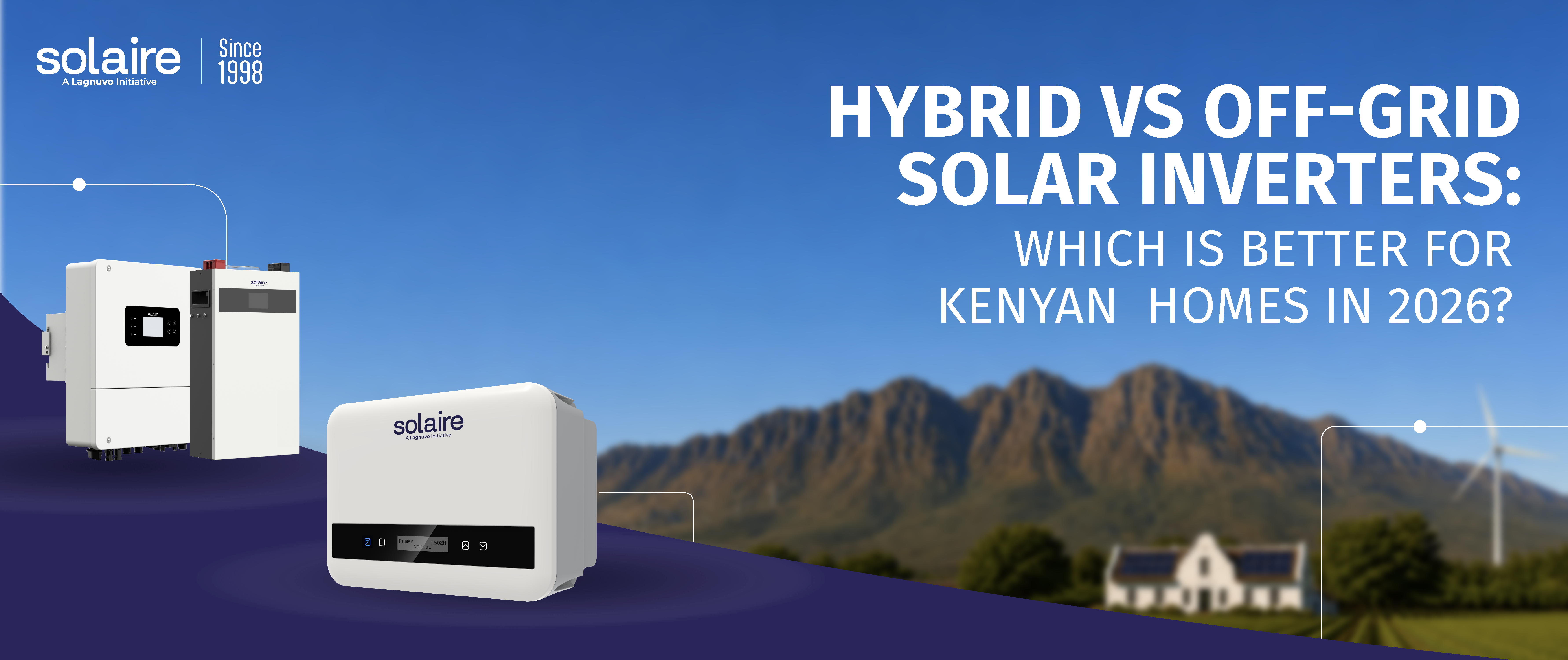
Hybrid vs Off-Grid Solar Inverters: Which Is Better for Kenyan Homes in 2026?
If you are planning a solar setup for your home in Kenya, one of the most important decisions you will make is choosing the right inverter. In 2026, many homeowners are comparing hybrid and off-grid systems because both can support energy independence, better power reliability, and more control over daily electricity use. But while they may seem similar at first glance, they are designed for different household realities.
The right choice depends on where you live, how dependable your grid connection is, how much backup you need, and how you expect your energy needs to evolve. In this guide, we will break down the main differences, explain the real inverter benefits, and help you understand whether a hybrid solar inverter Kenya setup or a more standalone off-grid system makes better sense for your home.
You can explore Solaire Africa's solar product portfolio to see the broader categories available for residential and commercial users.
What is a hybrid solar inverter?
A hybrid inverter is a system that can work with solar panels, batteries, and the utility grid at the same time. It allows your home to use solar power during the day, store extra electricity in batteries, and draw from the grid when needed. That flexibility is a major reason the hybrid solar inverter Kenya category is becoming increasingly relevant for households that want both savings and resilience.
One of the strongest inverter benefits of a hybrid system is that it does not force you to choose between grid connection and backup capability. Instead, it combines both. This makes it especially attractive for urban and peri-urban homes where the grid exists, but outages or voltage fluctuations still create inconvenience.
Solaire Africa's hybrid inverter solutions reflect this kind of flexible energy approach, with systems designed to support modern residential and mixed-use power needs.
What is an off-grid inverter?
An off-grid inverter is designed for homes that operate independently of the utility grid. It works with solar panels and batteries to create a self-contained power system, which means the home does not rely on grid electricity for normal operation.
This kind of system is often the better fit for remote properties, rural homes, or locations where grid access is weak, unavailable, or too unreliable to depend on. The biggest inverter benefits here are full independence and the ability to create a dedicated power ecosystem around your household's actual needs.
For homeowners looking at these systems, Solaire Africa also presents off-grid inverter options as part of its wider energy portfolio.
Which is better for most Kenyan homes in 2026?
For many Kenyan homes in 2026, a hybrid system is likely to be the more practical option, especially where the grid is available but not always dependable. A hybrid solar inverter Kenya setup gives homeowners the ability to use solar first, charge batteries for evening use, and still fall back on the grid when needed.
That matters because many households are not trying to disconnect from the grid entirely. Instead, they want a smarter backup strategy, lower electricity bills, and better daily reliability. In that scenario, a backup solar inverter Kenya solution based on hybrid architecture often delivers the best balance between independence and convenience.
An off-grid system, on the other hand, is usually better where total self-sufficiency is the goal or where utility access is limited. It can be a powerful solution, but it requires careful sizing of both solar generation and battery storage because the system must carry the entire home without grid support.
Comparing backup, flexibility, and cost
If backup is a top priority, both system types can help, but they do so differently. A backup solar inverter Kenya setup built around a hybrid inverter can use the battery for outages while still relying on the grid for support during low-solar periods. That can make system design easier and more flexible for many homes.
With an off-grid system, backup is not really a secondary feature — it is the complete system philosophy. The home depends fully on stored and generated energy, which can be ideal in some locations but less forgiving if the system is under-sized.
When it comes to inverter benefits, hybrid systems usually stand out for their adaptability. Off-grid systems often stand out for energy autonomy. Cost can vary based on battery size, load profile, and installation design, but many homes with some grid access find hybrid systems easier to scale and live with over time.
How to choose between the two?
We would look first at the grid situation in the home area. If the home has grid access but faces periodic outages, we will usually lean toward a hybrid solar inverter Kenya solution because it offers flexibility, future-readiness, and easier day-to-day power management.
If the home is in a location where the grid is absent or highly unreliable for extended periods, an off-grid solution may be the stronger option. In that case, the focus should be on accurate load planning, battery sizing, and choosing equipment that can support the household without compromise.
For homeowners who want to compare broader product directions, Solaire Africa's commercial and residential energy solutions show how different applications can be approached depending on scale and usage pattern.
Choosing the right fit for your home
The better choice is not the same for everyone. In 2026, the best system for a Kenyan home depends on whether the priority is full independence, smarter grid-supported backup, lower bills, or a combination of all three.
For many households, the strongest inverter benefits come from choosing a system that matches real-life usage instead of chasing the most extreme setup. If you want flexibility, battery support, and better resilience without leaving the grid behind, a hybrid solar inverter Kenya system may be the better path. If you want full self-reliance in a remote or weak-grid area, off-grid may be the right answer. In both cases, a well-designed backup solar inverter Kenya strategy starts with understanding how your home uses power.